
"natural water"
20000 article(s) found

Three main treatment methods of Costa Rican coffee raw beans Villa Manor Coffee beans Red Honey treatment process Flavor
Most of the coffee we see from Tarasu is washed coffee. Generally speaking, washed coffee has a very clean flavor. When you taste washed coffee, you mainly taste the coffee seeds and roasted flavor. Where the fruit comes from, ideally, the process it goes through has no external influence. Pick ripe coffee cherries from trees during harvest

Smart filter Cup of hand-made Coffee course-usage and extraction skills of Smart Cup
Professional coffee knowledge exchange more coffee bean information please follow the coffee workshop (Wechat official account cafe_style) Smart Cup use skills Smart Cup extraction principle introduce a variety of ways to extract a good cup of coffee, different extraction methods bring different factors, the same batch of coffee therefore coruscate their own excellent flavor map. Every time it's brewed

What are the types of coffee treated by natural washing
Natural washing coffee 1, choose beans: put the harvested fruit in the water tank, the ripe fruit will sink, while the unripe and overripe fruit will float up and can be removed. 2, drying: put the selected ripe fruit in the square for 5-6 days until it is fully dry. At this time, the fruit becomes dark brown, with a moisture content of 13% 3, shelled: after drying

Costa Rican Tarazhu Coffee Flavor description, Grinding degree, Taste characteristics, Manor introduction
The natural treatment process of French Sika is quite laborious. The artificially picked high-sugar coffee fruit is first placed in an African viaduct in the sun for about 10 days, and then placed in a plastic-covered greenhouse to create more direct heat and continue to dry. until the water content reaches 11.5%. The slow drying process allows raw beans to develop more natural sweetness from within, but it also needs to be more careful.

Flavor description of sunburned Kaduai Coffee beans introduction of Grinding scale varieties in Taste producing area
Description of the flavor of sunburned Kaduai coffee beans the variety of grinding scale in the producing area introduces the sun drying method because it uses natural sunlight to dry the fruits and raw beans of coffee, so it is also called natural drying method. Due to the use of artificial and natural treatment methods in the process, the sun-cured beans look irregular and unflattering in appearance. 1. Select beans: put the harvested fruit into water

Description of Red Wine Flavor of Raw Coffee beans introduction of manors in grinding scale producing areas
Red Wine treatment of Coffee Raw beans Flavor description Grinding scale producing area Manor introduction Honey treatment is used in almost all producing areas of Costa Rica. This method is also widely spread throughout Central America. Because the surface mucosa of coffee beans is extremely sticky and smooth and the sugar content is extremely high, it is often called honey. In the process of honey treatment, coffee will leave some or all of the honey when it is dried. Coffee fruit

Hawaiian Kona Coffee introduces boutique coffee beans in the Manoa Valley area of Oahu.
The climate is very suitable, the sun in the morning gently passes through the air full of water vapor, in the afternoon, the mountains will become more humid and foggy, and the white clouds surging in the air are natural umbrellas for coffee trees, and the evening will become sunny and cool. Suitable natural conditions make the average yield of Kona coffee very high, reaching 2240 kg per hectare, while in Latin American coffee.
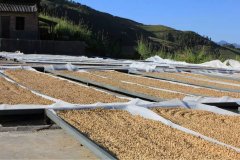
The treatment method of raw bean-- how to deal with raw bean by natural sun
The process of natural solarization is the simplest. The fruit begins the process of sun drying without treatment after picking. This is the oldest method of treatment in existence. This method is still used in places such as Ethiopia and Brazil. Natural solarization is most common in areas where water resources are scarce. The drying process usually lasts about 4 weeks. The way to deal with it must be very

What is the difference between the flavor and taste of coffee beans in the sun and in water?
The sun drying method is also called natural drying method because it uses natural sunlight to dry the fruits and raw beans of coffee. Due to the use of artificial and natural treatment methods in the process, the sun-cured beans look irregular and unflattering in appearance. 1. Choose beans: put the harvested fruit in the water tank, and the ripe fruit will sink, while the immature and overripe fruit will float up.

Coffee knowledge the natural hair dye for the wonderful use of coffee
Coffee hair dye tools and materials: coffee powder, old towels, electric caps see people who don't get stains instead of 13 at Starbucks, I can't help thinking that since coffee has such a powerful dyeing function, then the effect of hair dye should be leveraged! Hair dyeing steps: add coffee powder to boiled water that can keep your hair completely moist. The higher the concentration, the better. Cool the coffee juice

Mantenin Brazilian espresso bean flavor and taste characteristics how to match the coffee bean producing area
Follow the caf é (Wechat official account vdailycom) found that the beautiful cafe opened its own shop, Manning, mocha, Brazil for single coffee, Italian for blended coffee, mocha with chocolate flavor and a little sweetness, while Brazil not only has many estates, but also Arabica subspecies has large branches and many flavors, but Brazilian coffee is not as good as Manning and is often used for blending.

Description of Flavor of Water-washed Coffee and Solar Coffee Honey introduction of varieties produced by Grinding scale
Description of flavor of washed coffee, sun-dried coffee honey, grinding scale production area varieties of raw beans treated by drying method are yellow, and the water content of coffee beans is generally about 11% Mel 12%. The advantage is that sun beans have better sweetness and mellow thickness, and less sour taste, so many coffee fans like it very much. The disadvantage is that artificial and natural processing methods are used in the process, so

What are the ways of handling raw coffee beans? A list of specific steps of solarization treatment
In the treatment of ◎ coffee beans, the harvested fruit must immediately enter the processing process, otherwise it will begin to ferment and make the coffee beans smell. The treatment methods can be summarized into two kinds, which are "solarization" Sun Dry and "water washing" Washing, which will create different flavors. Sun-cured beans have a complete natural mellow flavor of Full Body, gentle

The wonderful use of Coffee Coffee steps for dyeing hair with pure natural hair dye
Coffee hair dye tools and materials: coffee powder, old towels, electric caps see people who don't get stains instead of 13 at Starbucks, I can't help thinking that since coffee has such a powerful dyeing function, then the effect of hair dye should be leveraged! Hair dyeing steps: add coffee powder to boiled water that can keep your hair completely moist. The higher the concentration, the better. Cool the coffee juice

Introduction to the characteristics of flavor description treatment method for roasting degree of raw and ripe beans of El Qomolangma coffee
Country of production: El Salvador; Garden name: Saint saliva production period: 2006 / 2007 defects Specification: 6 defects / 300g size Specification: over 18 mesh 95% Coffee Variety: Pacamara, it is a hybrid between wave and giant beans. Flowering period: April-May harvest period: December-March other: processing method completely washed, 100% natural drying, origin mark

Treatment of Coffee fruits Coffee bean treatment
I would like to introduce the treatment of coffee fruits and the comparison of different ways. The following picture shows an enlarged coffee bean with pectin, in which pectin, parchment, silver skin and raw beans are clearly distinguished. Classification of Processing Method Coffee Fruit treatment methods are divided into dry (Dry Processing) and wet (Wet Processing) treatments according to whether the peel is removed or not.
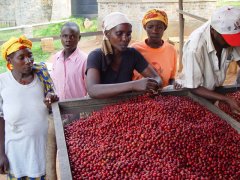
Dry treatment is also called natural all-day tanning.
Dry treatment (secado), also known as natural all-day exposure (natural). After the coffee fruit is actually picked, it is dried directly in the sun. According to the weather conditions, it is generally necessary to dry the coffee beans for 2 weeks to reduce the water content of the coffee beans to 10%, 12%, and then use a machine to remove the dried peel and pulp. The raw bean processing plant (beneficio) usually retains the parchment shell on the outside of the coffee bean when the raw bean is stored.

Washed or dry? The relationship between the handling method and the level name
The coffee beans baked by us as ingredients are actually the seeds in the coffee fruit. Coffee farmers give the fruit another name, coffee cherry (Coffee Cherry). If the pulp is separated from the seed, and how to dry the seed into a state that is easy to preserve, the whole process is collectively referred to as treatment. Due to the effect of the treatment process on the quality and flavor of coffee beans

Differences in raw bean treatment of coffee beans treated with sun, water, semi-water and honey
The first is dry treatment (secado), also known as natural all-day exposure (natural). After the coffee fruit is actually picked, it is dried directly in the sun. According to the weather conditions, it is generally necessary to dry the coffee beans for 2 weeks to reduce the water content of the coffee beans to 10%, 12%, and then use a machine to remove the dried peel and pulp. The raw bean processing plant (beneficio) usually keeps the outside of the coffee beans when the raw beans are stored.

There are several kinds of coffee in the treatment of coffee beans.
In the process of washing, the peel and pulp of the fruit are treated with a special desizing machine and the coffee beans are peeled off. The coffee beans then enter the fermentation tank for fermentation treatment so that the mucous membrane is no longer sticky. The sugars in the mucous membrane are decomposed during fermentation. Depending on the fermentation method, the fermentation time is usually 12 hours to 6 days (some growers use the watering system to ferment coffee beans. This kind of square